Sunday, August 12, 2018

Mission: Impossible - Fallout Review

The newest entry in the Mission: Impossible franchise is in theaters now. The series has never blown me away, but the buzz was good, so I decided to see if this one would change my mind on the series.
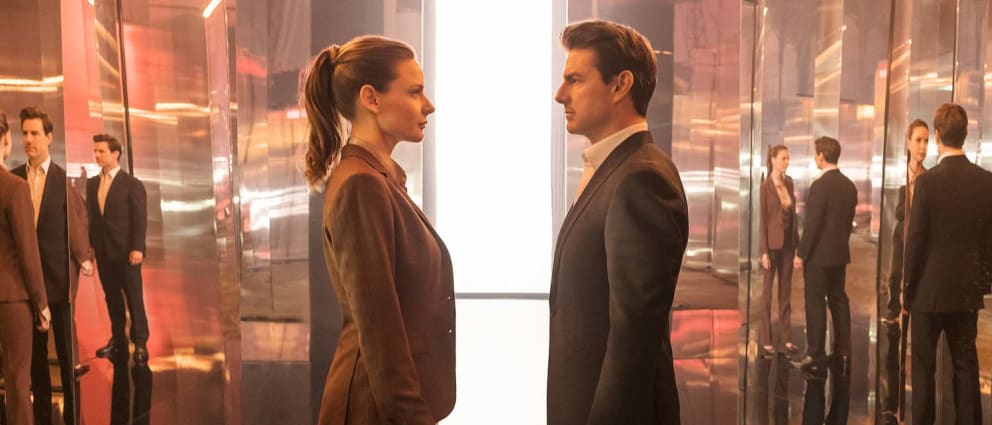

Starring Tom Cruise, Henry Cavill, Rebecca Ferguson, Simon Pegg, Ving Rhames, Sean Harris, Alec Baldwin, Michelle Monaghan, Vanessa Kirby, Angela Bassett
Written and Directed by Christopher McQuarrie

Synopsis: After losing a dangerous macguffin to a terrorist group, superspy Ethan Hunt save the world by taking a path that leads him back to a former enemy.

Visuals and Audio: Amongst the major spy franchises, Mission: Impossible has never been the most stylized. Bourne created a style of its own, and though 007 lacked consistency, its efforts to keep up with the times have often led to striking and distinct visuals. Aside from John Woo's efforts at #2, the Impossible franchise has been less visually dynamic, occasionally to its detriment. However, this film uses that to its advantage. Though not altogether distinct, the visual style goes 100% into making the action look as good as possible. Rather than using quick cuts and other tricks to hide stunts, said stunts are the bread and butter of this franchise, so the cinematography keeps the view of the action crisp, clear and easy to follow. There is something exciting about knowing that what you're seeing really happened, without much in the aid of CGI or tricky editing. The sound design is where this film really excels though. Every impact, every hit every moment carries a power, behind it. Sometimes called the "Oomph" factor, this mixture of clear visuals and crisp, intense sound is exactly what leads to the audience wincing during the hits, and leaning back when there is a large fall a character is facing, creating a level or immersiveness that is unusual nowadays.

Cast: Though certain characters have returned in this series, each installment tends to have a largely new supporting cast. For the first time, though, Fallout seems to be mostly focused on the same characters that Rogue Nation portrayed. Rebecca Ferguson and Sean Harris are back respectively as Ethan Hunt's sometimes accomplice Ilsa and his enemy Solomon Lane. Franchise regulars Ving Rhames and Simon Pegg fill out the rest of Hunt's team. The benefit to this is that the audience and actors are largely familiar with these characters, giving the film a sort of comfort and easy chemistry, wherein the main players don't need an excessive amount of introduction. However, this somewhat leads to the downside where few of the characters add anything new to their roles. The only one to really expand is Ferguson, who is the film's strongest actor for the second installment in a row. Though her Ilsa is familiar, she has new struggles that feel natural for the character, and her chemistry with Cruise is strong, but not without a certain level of uncertainty which aids the characters well. As for Cruise, there's very little to say. His passion for the series is undeniable at this point, and shows no signs of faltering anytime soon. His sheer physicality continues to be the main draw of the series, as watching the star clearly putting his life and body at risk for our entertainment will never truly lose its appeal. Dramatically, there isn't much ground broken for Ethan Hunt in this film. There are some attempts at giving Ethan personalized stakes, but the character has always been more comfortable jumping off of buildings than showing intimacy, leaving Ferguson the emotional heavy lifting.

The two significant new characters really add to the dynamic. Vanessa Kirby's White Widow is a new, sort of morally grey antagonist to the series. The character doesn't have a ton of depth, but Kirby is clearly having fun with the uniqueness of the role. More important is Henry Cavill's August Walker. A CIA agent assigned to watch over Ethan Hunt, Cavill proves to be the perfect foil for the protagonist. August Walker is described in the film as a hammer to Ethan Hunt's scalpel, and that description is perfectly applicable throughout the film. He carries a sense of brutality and simplicity that constantly gets in Hunt's way, and serves Cavill throughout the fight scenes. (I don't have to describe how oddly intimidating the moment he "reloads his arms" is, and how not intimidating it would be in anybody else's hands.) As such, he proves to be the film's most interesting adversary, even with the return of the previous film's big bad, Solomon Lane.

Writing: Oddly even for an action film, the Mission Impossible series usually shoots without a real script. There is an outline, and the director and Cruise have talked about the story arc, but the film is usually made up as filming goes on. This is to keep the focus on the things people come to these movies to see: stunts and action. As such, critiquing the writing is a little difficult since, in truth, it doesn't really matter that much. Is the storyline interesting? Not particularly. It's pretty basic and predictable spy-stuff. Is the dialogue strong and realistic? No, although there's less overt exposition than one would expect, which is nice. The one real strength in the writing here is how it avoids the greatest issues of previous films in its own series. Both Ghost Protocol and Rogue Nation spent their first halves building up to their second-act set pieces, with the third act being more of an "and-then" situation without as much anticipation. Fallout instead constantly builds up and readies itself for its final act, keeping that sense of anticipation throughout. As such, it's third act feels like less of a letdown than the previous two, and the audience exits on a higher note.

Directing: Interestingly, Christopher McQuarrie is the first director to return to this film franchise. Though Cruise had long wanted each film to have a different directorial style, he has had a great working relationship with McQuarrie over the last few years, continuing well here. Though McQuarrie puts the smallest personalized stamp of any of the franchise's directors, that actually does benefit the film somewhat. He really has a great understanding of what the audience wants, and how to deliver it to them. A bare minimum of focus is given to emotional and character development, while the rest is about building tension and excitement with fantastic set pieces in cool locations. This works since there is just enough character development for the audience to feel invested, largely resting on previous films, and a sense of simple motivations. It's not the most unique spy film, but it has a great pace that keeps the audience from realizing just how long it is, and he never lets the excitement die down for too long, using his quieter scenes to set up the next big loud one. There are a few cool flourishes he gives, but McQuarrie never lets himself get in the way of Cruise and the stunts, which, for this franchise, is just what is needed.

Verdict: If you aren't a fan of this franchise, Fallout won't do much to convert you. At the end of the day it is just another Mission: Impossible film. That being said, it's the best version of a Mission: Impossible film. Come expecting to see cool stunts and action, and not much more, and you won't be disappointed.

Grade: 8.6

Sunday, August 5, 2018

The Avengers Review

After four years of setting up their main characters, Marvel unveiled its magnum opus: The Avengers. Though not the first crossover film ever made, this film was the most ambitious, in how it kept the continuity of all of its origin films and managed to balance the different characters, prompting many other studios to start making their own cinematic universes. 


Starring Robert Downey Jr., Chris Evans, Chris Hemsworth, Mark Ruffalo, Scarlett Johansson, Jeremy Renner, Tom Hiddleston, Samuel L. Jackson, Clark Gregg, Cobie Smulders, Stellan Skarsgaard
Written and Directed by Joss Whedon

Synopsis: When Earth comes under the threat of an alien invasion, S.H.I.E.L.D. decides to bring together the greatest heroes the planet has ever seen to prevent global domination.

Visuals and Audio: The first major thing of note is that The Avengers is the first film in the Marvel Cinematic Universe to have a theme that would be used again. Though character themes were developed for the other films, they remained in those other films, with new themes being developed for the sequel, save one or two moments. The theme Alan Silvestri composed for this film, however, has remained the main theme of The Avengers series all the way through Infinity War. As far as themes go it's pretty decent. It feels triumphant and heroic, which is very fitting for bringing six heroes together. It feels a bit like a missed opportunity, however, to not use the character's individual themes together at all, as it could have carried a thematic resonance. Likely the decision was made due to the characters mostly lacking memorable themes, but it's still a shame.

Visually, there's oddly not that much notable. The effects are good, though not groundbreaking, and the editing and cinematography do their job. The major aspects of The Avengers come in its acting and writing. The technical side of the film certainly doesn't hold it back, but it doesn't push itself forward in any significant way either.

Cast: The big question surrounding this film before its release was how Marvel would manage to balance six protagonists, four of whom had already led their own films. Thankfully, all of the actors are fully on board with the needs of the film. While a situation like this can to actors fighting and pushing to be the "main" character, the actors here all accept the film as an ensemble and allow themselves to work within the group. Chris Evans' Captain America and Robert Downey Jr.'s Iron Man do seem to have the most screen time, but they play off each other well, falling easily into their roles within the group without losing the characterizations they developed in their own films. Scarlett Johansson's role is heavily expanded from her introduction in Iron Man 2, and very much for the better. She is playing an actual character here, who is allowed to fully keep up with the rest of the team, and never shortchanged or used solely for titillation. Chris Hemsworth's Thor has less to do. This is likely due to the fact that his villain is the antagonist of this film, and if he were more prominent it would feel more like a Thor sequel than a true Avengers film. He doesn't have an arc of any sort, but Hemsworth manages to feel comfortable in his role, and he absolutely nails most of his comedic dialogue. Finally, the two new additions to the cast are Jeremy Renner as Hawkeye, and Mark Ruffalo, who takes over the role of Bruce Banner from Edward Norton. Renner doesn't make much of an impression, spending half the film as a mindless henchman before showing up in the finally to basically just fire some arrows at the enemies. Ruffalo's impact is far stronger. His Banner is much less intense than Norton's, albeit not completely lacking, which befits a character who was designed to fit into an ensemble. Ruffalo has fun with the role, finding a certain sense of humor in the character's predicament. Ruffalo also plays the Hulk through motion capture, and the character is given many of Ruffalo's facial features. For the first time the Hulk feels like the same person as Bruce Banner, which allows their situation to be more relatable. The Hulk himself is made far more fun to watch in this film. Though the character is still uncontrollable and unpredictable, this film uses those traits for comedy rather than for terror. This allows the character to be fun, as well as to not dominate the entire film.

The next step is finding a villain worthy of bringing together an entire team of superheroes. You can speak to the Justice League for confirmation that this is easier said than done. Rather than picking a new villain, The Avengers played it safer and took the best villain they had already introduced: Loki. Tom Hiddleston's performance as Thor's troubled younger brother was the highlight of that film, and he is similarly strong this time around. Now fully evil, Hiddleston makes the most of his scenery chewing, turning mischief into full blown malice and having a ball doing it. though his character is a far bigger threat this time around, he hasn't lost his sense of tragedy from Thor, and the trauma the character has felt is apparent through his actions, and through his more disheveled appearance. He manages to be a perfect foil for each of the Avengers, and gives the proper mix of threat and charisma to warrant an entire team of protagonists to bring him down.

Writing: Easily the largest challenge faced by the film was how to handle the screenplay. This movie had to balance six protagonists: four who had already been developed, one who had barely been introduced and a final one who had been recast with a personality change. On top of this, the film had to create a credible, yet interesting, threat that would feel large enough to warrant an "event" film. Finally, on top of all of that, it had to also be entertaining. To handle all of this, Marvel hired Joss Whedon, a television veteran who had specialized in funny and exciting ensemble television series. This proved to be the perfect choice for the film. Whedon gives most of the Avengers arcs of their own that complimented one another, and a strong and emotional villain arc that was more than just "big guy wants to take over the world." The way the characters interact, argue and finally work together feels genuine to how they had been established in their previous films, except for Hulk and Black Widow who are far improved from their introductions. Whedon also stacks the film beginning to end with his specific brand of witty, quippy dialogue. While this is a trait that would become somewhat overused in later films, here it serves to keep the film's tone light and bubbly. This way the movie never loses its sense of fun and whimsy, even when the stakes are highest. It also helps that most of these lines are very funny, and the actors posses capable timing to make them work at their highest. While the overall plot arc of the film is exceedingly simple, everything that had to go into making it work was so incredibly complicated that simple was about the only way it could have succeeded. While later films would add more wrinkles to the plot, anything more here would have weighed the film down. Those later films needed this one to establish the idea of these characters interacting and saving the world together, and the way The Avengers goes about that is absolutely what these characters and this world needed.

Directing: This was the first film in the Marvel Universe to be written and directed by the same person. This does come through on screen, as the film has many of the makings of a standard Joss Whedon production. This occasionally errs into a mistake, but manages to just avoid it. The thing that keeps it from falling down that hole is that the characters still feel and behave as they did in their prior films. Tonally, the Joss Whedon style is very light and fun. Though he has had heavier moments in his history of film and television making, he mostly avoids them here. The result is a film that moves quickly through its two hour plus run time, making sure every scene has some reason to keep the audience invested. There are occasional moments where this is lacking, but they are quick enough that the film never really loses the audience's interest. The sheer level of fun and enjoyment that Joss Whedon creates is admirable, and a huge reason as to why this film was and is a success. Even with as light as the film feels, Whedon still manages to give the final act some impact. He is able to tap into the differences between the characters so well, that the moment they all come together to fight off the threat, it feels like a momentous occasion. This final sequence becomes a standout action beat, and served as the Marvel third act template for several years.

Verdict: Possibly the most ambitious film of all time when it came out, The Avengers stands as a non stop thrill ride of fun. A nearly perfect balance of its ensemble and a hyper-focus on entertainment value and enjoyability take what could have been a messy film, and allows it to feel so coherent that some viewers felt it too simple. It's not a tremendously emotional film, but it is a tremendously entertaining film. It feels like a true event, one that served single-handedly as a proof of concept. It's such a success that many studios are still trying, mostly unsuccessfully, to copy it. However, it truly does feel like lightning in a bottle: the perfect mix of patience, talent and luck, that forced its series to be taken seriously in the popular zeitgeist.

Grade: 8.5

Saturday, August 4, 2018

Captain America: The First Avenger Review

And now comes the film that comes first chronologically in the MCU, and with the series' first subtitle to let the audience know that this is their first period piece. A lot of firsts for the fifth film in the series.

Starring Chris Evans, Hayley Atwell, Hugo Weaving, Tommy Lee Jones, Stanley Tucci, Dominic Cooper, Toby Jones, Sebastian Stan, Neal McDonough, Derek Luke
Written by Christopher Markus & Steven McFeeley
Directed by Joe Johnston

Synopsis: During World War II, scrawny aspiring soldier Steve Rogers is given a serum that turns him into a super soldier, who must then take down a secret science division of the Nazi Party.

Visuals and Audio: As Marvel's first period piece, The First Avenger is their first film to try to take on a stylized look. The film's aesthetic is a mix of classic 40s propaganda, and 50s sci-fi. While this mixture might seem odd, it's actually a really solid method of allowing this to be a war film without losing its comic book heritage. The villains take on the more advanced 50s aesthetic: sleek, rounded blacks and grays, bulky laser weapons and uniforms that hide any sense of individuality so they may as well be robots. Meanwhile, the American soldiers exist more or less as one would expect them to. They wear dirty tattered uniforms, drive period accurate-ish vehicles, and don't take too much of a role in anachronism. Still, this film's depiction of World War II owes much more to the films that were released in the first few decades following the war, and none of the gritty realism introduced in the late 80s and 90s is to be found. Even so, this allows the film to be a "fun" war film, something that could have been released in the early 80s. The visuals, along with the music and delightfully dated sound effects, have an old school charm to them that helps this film to stand out.

The only technical downside is that the film is filled with B-level CGI. There are countless shots where the characters look like they were cut and pasted onto computer generated backgrounds that were several years out of date by the time this film was released. A better alternative would have been to go full 80s and use miniatures and matte paintings, with CGI simply smoothing the seams out. While it may not have looked more realistic, it would have been more endearing and nostalgic. Instead, it saps some of the charm that the music, production design and sound added. Still, the effect of Chris Evans head on a scrawnier man's body holds up as impressive. It's hard to see the seams of where Evans ends and the double begins, although the proportions seem very off.

Cast: Chris Evans had an incredibly difficult job ahead of him. Making a totally goody-two-shoes character interesting is a major challenge, one which Christopher Reeve is nearly alone in accomplishing. Still, Evans joins him at the podium. He succeeds where others have failed by finding what it is inside Steve Rogers that makes him so morally strong. Rogers isn't simply good because he's the hero, he's good because he's spent his whole life as a weakling. After years of having no agency in his life, and no way to fight the bullies who have plagued him, he has a real appreciation for what the powerless go through, and a real desire to help them, whether or not he has the physical capabilities. We are able to relate to him because of how much this makes sense to us, and we can attach to him and root for him throughout, even without those humanizing gray areas.

Though it's fully Evans (and Rogers) movie, the supporting cast actually adds a lot of enjoyment. Hugo Weaving's Red Skull, is a fun and fitting antagonist, albeit not particularly nuanced. The character lacks moral gray areas, much like the hero of the film, and instead mustache twirls as much as a man without a face is capable of. He is evil through and through without the slightest drop of compassion; fitting for the head of research of the Nazi's. Hayley Atwell's Peggy Carter is also an excellent character, and the film's main example of modernization. Despite being set in the forties, Peggy Carter manages to overcome the era's sexism to have some real agency and drive, commanding the respect of those around her. Though Atwell's performance as an intelligence officer is top notch, she struggles (as does Evans) with the romantic subplot. Steve Rogers and Peggy Carter share a chemistry with each other, but rather than let that drive the romance, the film tries to up the drama by forcing roadblocks between the two characters. Though it's more of a writing issue, the two leads struggle to prevent their characters from seeming immature as a result of it. Tommy Lee Jones, Stanley Tucci and Toby Jones spice up the ensemble cast. Their characters have no depth, but they are fun to watch and keep the viewers interested. The one weak point in the cast is Sebastian Stan as Steve Rogers' best friend Bucky Barnes. Though he'll go on to be a major character in the MCU, and a better actor, theres very little charisma or interest to Bucky here. He's a plot device mean to motivate Cap more than he's a character, and gives little indication of the great drama he'll be a part of in the Captain America sequels

Writing: The screenplay for The First Avenger suffers from a similar issue to many of these early MCU films: They start stronger than they finish. The first half of the film is very interesting. Spending nearly a third of the film with Rogers before he becomes Captain America allows us to connect with him, and seeing him in this pathetic state makes his pure selflessness easier to swallow. The sequences leading up to Rogers first major superhero act: liberating a POW camp, are fun, character driven, and follow a fully satisfying three act structure. However, after that sequence passes the storyline begins to falter. Steve has already had his full arc at this point. He started out unable to help those who couldn't defend themselves, and through embracing the fact that his good heart was what made him a hero, he acquired the ability to do the good he wanted to do. However, after all of this is still nearly an hour of screen time. What's left at this point is just a good guy and his friends fighting a bad guy and his henchman. The character driven scenes are instead relegated to the Steve/Peggy romance arc, which has already been mentioned as being botched. Though the audience wants to see these two characters together from their very first shared scene, the screenplay feels the need to delay their getting together, seemingly in hopes that it'll make the moment they do more satisfying. Rather than build up their courtship through natural scenes of emotional intimacy, they force in misunderstandings to keep them apart. Steve thinking Peggy is with Howard Stark because they get fondue together, or a nurse surprising Steve with a kiss right when Peggy walks by are not plot developments that feel genuine or interesting. They are blatant emotional manipulation, and they hurt the characters without adding any emotional weight to the moment they do get together. It's simply too obvious to the audience that there's no good reason these characters aren't together, and the resolution falls flat as a result. This is made more obvious by the fact that the rest of the film around them has no real drive towards the conclusion. Captain America simply fights the Red Skull's men in many different scenarios, and then suddenly it's the final showdown. There's very little emotional weight behind it, and as such the film's resolution lacks punch.

Directing: Joe Johnston is an old-school style filmmaker, and was really the perfect choice for this film. Cutting his teeth in the Visual Effects Department of Raiders of the Lost Ark and the original Star Wars trilogy, Johnston has a long history of bringing that old school feel to his films. Though his filmography as a director is light on true classics, he manages to bring a real separate flavor to The First Avenger. Even when the writing fails to give the film dramatic weight, Johnston is able to keep the film light and entertaining, with a sense of adventure and fun that puts the film tonally in line with Indiana Jones as much as with Iron Man. Though he struggles to make the romantic plot work, Johnston shines in the film's action beats, giving them a quick paced thrill that doesn't emotionally tax the audience. A few moments of his "Gee-wiz" sentiment can prompt eye rolls early on, but Captain America: The First Avenger never asks its audience to believe that it is real, it embraces its falsehood and simply asks the audience to enjoy the fireworks. Through these elements, Johnston easily cements himself as the second strongest force in this film, behind only Evans.

Verdict: Many elements in Captain America: The First Avenger toe the line of greatness, but the film unfortunately tells too much of its story too early. As such, where it should be hurtling to a stirring and epic conclusion, it instead is forced to use cheap narrative tricks to shamble to the two hour mark. If the film had expanded its first half into being the entire story arc, with the POW camp liberation serving as the film's climax, it could have served as a great origin story. As is, the movie is still loads of fun. It's got a great style, and Steve Rogers/Captain America is cemented instantly as being very much in the conversation as the Marvel Universe's strongest character. It's absolutely worth a watch, especially for those who miss the 1980s style of action and adventure. It's just frustrating to see the film being brought down through easily avoidable narrative threads.

Grade: 6.9

Thursday, August 2, 2018

Thor

Time to blast off of Earth for the first time in the Marvel Universe, and get our earliest taste of the further stretches that would await us.


Starring Chris Hemsworth, Natalie Portman, Tom Hiddleston, Anthony Hopkins, Stellan Skarsgaard, Kat Dennings, Jamie Alexander, Colm Feore, Clark Gregg
Written by Ashley Edward Miller & Zach Stentz and Don Payne
Directed by Kenneth Branagh

Synopsis: After his impulsiveness nearly starts a war, Asgardian prince Thor is banished to Earth until he can prove he is capable of handling the responsibilities that face him.

Visuals and Audio: This is an interesting film in terms of its visuals. While comic book films until this point had stayed pretty close to Earth, Thor's source material comes from another realm. As such, this was the first film in the MCU to have the opportunity to create a world. It handles this regard beautifully. Asgard is gorgeously rendered, mixing its Ancient Norse influences with the technological enhancements that would come about with a civilization this old. The main problem with this is that the other realms pale in comparison. Half of the film takes place in a small town in New Mexico. Said town has very little of note visually, and provides little in the way of flavor or character. This can't be anything but a letdown from the beauty and epicness off Thor's home realm. Thankfully the film still cuts back to Asgard throughout the runtime, and the first and third acts are primarily based in this realm, but the second act really drags, largely because there's nothing interesting to look at most of the time. It also constantly uses dutch angles. While this has been used effectively to throw off the audience's comfort level, but here they just feel like they're being used for no reason, which does little but distract the audience. Thankfully the film's score is very strong, serving as the best in the MCU at this point in time. It's stirring and melodic, effortlessly combining romance and adventure together. "Sons of Odin" still ranks as the MCU theme I was most sorry to see be forgotten, and "Can You See Jane" helps end the film on a very strong note.

Cast: By this point, Marvel was starting to fill their casts with heavy hitters. While some would be wasted, Thor mostly uses them somewhat well. Thor's father Odin would have been fine in many hands, but entrusting the character to Anthony Hopkins gives the role a sense of prestige and legitimacy that could otherwise have been lacking. On the downside is that Idris Elba was cast in a minor role just before he hit it big. He makes Heimdall one of the coolest characters, but his slim screen time feels like a waste. (Though future attempts to expand the character's role would feel forced.) The human characters are the weakest, by far. Though Stellan Skarsgaard is fine, Kat Dennings' comic relief character is more annoying than funny. Natalie Portman's Jane Foster is also supremely disappointing as a character. While Gwyneth Paltrow's Pepper Potts was a character who could easily have been one-note, a smart script and strong performance gave her some real agency and nuance. Here, Jane Foster feels like she could have been a stone's throw away from being empowering, but both Natalie Portman and the screenplay only see her importance as being a thing for Thor to fall in love with. In addition, Portman's performance is just... odd. Her line readings are all over the map, like she could never tell whether a moment was supposed to be serious or funny. As a result, she bounces all over the spectrum, leaving little ability to be taken seriously as a person or as a realistic love interest.

Thankfully the film really nails its two most important roles. Chris Hemsworth's role as Thor is textbook star-making. He brings such a natural charisma to the role that you are interested in his story, even when he is at his least likable. He also handles the character's growth well. Thor has clearly become a better person by the end, but you can still see first act Thor within third act Thor and vice versa. The real breakout by far, though, is Tom Hiddleston as Thor's trickster brother Loki. Hiddleston brings heart, fun and a real sense of mischief to the role. He takes full advantage of the brotherly connection between the hero and villain of the film, using that connection to hammer in the emotion at the heart of the film's main narrative. The chemistry between these two leads is astounding, and helps to make up for the films other flaws.

Writing: Again, the screenplay is a mixed bag. The decision to set half of the film in a podunk town in New Mexico proves to be a mistake. The narrative of the film really stalls while we are introduced to the film's least interesting characters. This section also attempts a lot of comic relief with Jane Foster and Darcy, but very little of it actually lands, largely due to the performances. The best part about this sequence is Hemsworth himself, as his dialogue sounds accurately different, and he has the best comedic timing. The real narrative weight, however, comes from Asgard. Though Thor's storyline is pretty straightforward, Loki's arc is actually more emotional and interesting. Loki has some real tragedy in his backstory, and a sense of pathos and motivation that is lost elsewhere in the film. The best decision the screenplay makes is to have the connection between the two brothers be the heart of the story. While they spend most of act 2 separated, the first and third acts bring them togethers, highlighting the changes the brothers have gone through. As such, the screenplay makes up for its mistakes by really making the most important storylines work.

Directing: Kenneth Branagh was a very inspired choice to direct this film. His Shakespearian past adds a feeling of history and grandeur to the film's scenes on Asgard. This film marks the closes the Thor series has come to feeling like the mythology on which it's based. The scenes with Thor and Loki have a sense of intensity and passion that are not often seen in the superhero genre, and as such Loki's sudden but inevitable betrayal hurts a lot more than it could have. However, sounding like a broken record at this point, Branagh struggles to make Earth as interesting. His efforts seem to suggest that he was trying to use comedy to cover up the narrative stalling and relative boredom of the Earth segment, but lacking any visual comedy, and leaving most of the comedy to the film's more confused actors, it doesn't work, and the film really drags through the middle. Thankfully, the Asgard sequences turn out to be more important, and so Branagh's directing works more than it doesn't, although it's close.

Verdict: Though it struggles in a lot of moments, Thor's strengths manage to outweigh it's weaknesses. The Asgard scenes are still some of the most epic and emotional scenes that Marvel has produced, although there's a lot of weak earth material in between them. If you're looking for action or humor, Thor really isn't the film for you, but if you want your superhero with a heavy portion of epic drama and world building, it will absolutely satisfy.

Grade: 7.0

Tuesday, July 31, 2018

Iron Man 2

Continuing right along with the film that didn't give much hope that Marvel could pull off their shared universe. How wrong that would turn out to be.


Starring Robert Downey Jr. Gwyneth Paltrow, Mickey Rourke, Don Cheadle, Sam Rockwell, Scarlett Johansson, Jon Favreau
Written by Justin Theroux
Directed by Jon Favreau

Synopsis: Dying from his suit, Tony Stark turns to alcohol abuse in what he thinks are his final days, while a bitter former rival seeks revenge.

Visuals and Audio: For the most part, this film fares as well below the line as the first one did. The effects are solid, as are the editing and cinematography. The filmmaking is all pretty solid, nothing too excellent or flashy, but it gets the job done well enough.

Cast: While nobody's arc is as strong as they were in the original Iron Man most of the cast still does a decent to good job. Downey Jr. manages to hold the drama and comedy together, even in its more forced moments, and Paltrow has less to do this time around, but still serves as a grounding presence. Don Cheadle is a minor improvement upon Terrence Howard in the role of James Rhodes/War Machine, although that's likely due to the script allowing him to banter much more. The final positive acting note comes for Sam Rockwell, who's Justin Hammer is easily the best part of the film. Taking full advantage of being the secondary antagonist Rockwell has an absolute blast chewing on the scenery and taking advantage of his plentiful comedic dialogue.

On the contrary, the worst part of this film is it's villain: Whiplash. Played by Mickey Rourke, Whiplash is a mishmash of poorly connected ideas and visions. While other MCU villains may be less memorable, the sheer disconnect from screenplay to performance cements Whiplash as a real low point for the series. Add in his bland motive and various oddities (like that frickin' bird) and you have a character who never had much hope in the first place. As well, this film adds in SHIELD in a big way. Nick Fury, Phil Coulson and Scarlett Johansson all have significant roles to play in this film. The problem is that Marvel hadn't properly figured out how to set up a shared universe yet, so all of their dialogue is incredibly forced and unnatural, preventing the characters from having a chance to feel important or real. Johansson has the most prominent role, and also fares the worst. Though she would go on to become one of the MCU's strongest female characters thus far, here she only serves for sex appeal, and never finds any semblance of nuance or character to flavor that. It's an especially unfortunate treatment of a prominent female character, especially in the same series that created a three dimensional love interest who was able to fully avoid most stereotypes.

Writing: Alright, here we go. The first third of this film is actually pretty solid. It does a decent job of setting up Tony's impending death and conflicts with the government, all leading up to a pretty fun action sequence on a racetrack in Monaco. Unfortunately, after this the film almost immediately loses track of the plot and devolves into a series of subplots fighting for prominence. As mentioned before, Marvel hadn't quite figured out how to connect their films, so SHIELD's role in the film, which serves only to set up The Avengers feels very tacked on, and distracts from the primary storylines. The dialogue in these scenes is also truly atrocious. One particular scene in which Nick Fury motivates Tony Stark to create a new element is likely the single worst scene to come out of this cinematic universe. Aside from the scene having no reason to exist beyond giving Samuel L. Jackson some screen time, the dialogue within is forced, out of character, and in no way resembles human speech. Though the film is already struggling to stay cohesive by this point, this scene really stands out as a major low point, and leads to one losing whatever suspension of disbelief may have still remained.

Directing: Much like the screenplay, Jon Favreau's direction peaks in the first act this time around. An early scene of Tony testifying in front of a senate committee is hysterically funny, and the aforementioned racetrack fight scene is stronger than any action sequences in the first film. It contains a level of intensity and brutality that wouldn't be seen again in this series until The Winter Soldier. (Hell, Happy Hogan straight up rams Whiplash with a car three damn times!) Once this scene passes, Favreau struggles to continue any sort of a consistent tone. While the first film managed to deftly blend drama and comedy, this film leaves them almost entirely separate from each other. The result is that the comedy feels unnecessary and silly, the drama feels uninteresting, and nothing seems to have any importance whatsoever. Because of this, the emotional and exciting scenes fall far short of their potential, and the entire film feels like a clip show.

Verdict: Lacking in any sort of cohesion, Iron Man 2's main issue is that it simply doesn't feel like a film for much of its time. There are too many ideas at play, and none of them are given the attention necessary for their impact to be felt. Though there are some strong performances, and the effects are still solid, the best thing about this film is that it served as an early lesson for Marvel, teaching them what not to do in their future. Thankfully, they took the lesson to heart, and did a much better job at telling their individual stories from here on out. Still, it's worth watching the first third, and pretending it's just a fun short film with the Monaco Raceway fight serving as the climax. It still feels unimportant, but it honestly works better than it ever should.

Grade: 4.9

Monday, July 30, 2018

The Incredible Hulk Review

Continuing on this trip back through the MCU comes Marvel's perhaps most forgotten film, The Incredibe Hulk. Hardly ever referenced, even within Marvel's canon, is there secretly some brilliance hidden in Marvel's second film?


Starring: Edward Norton, Liv Tyler, Tim Roth, William Hurt, Tim Blake Nelson, Ty Burrell
Written by Zak Penn
Directed by Louis Leterrier

Synopsis: On the run from the US government, Dr. Bruce Banner tries to find a way to cure himself of his destructive split personality, The Hulk, before it can cause too much damage.

Visuals: Being in production the same time as Iron Man,  The Incredible Hulk is the only MCU film that can't claim to be influenced by it. Does this mean it was able to make its own visual style? Sort of. The first act of the film, taking place primarily in Rio De Janiero, has a cool look and feel to it. This act contains the first "Hulk" sequence of the film, wherein the big green guy is kept in the shadows, and his attack is seen from the point of view of the mercenaries chasing him. This allows for some cool work with light and shadows, building the suspense of The Hulk before revealing him. It also greatly helps hide the fact that the effects suck. The Hulk never really looks like he's there. The film's climax, which features him fighting another big CGI guy looks especially cartoony. It's also a shame that the visual style falters after leaving Brazil. The rest of the film is either bright and bland, or too dark and murky. Either way it fails to be memorable.

Audio: Musically, this film recycles its main theme from the television series of "The Incredible Hulk." This is actually a great idea. It is a very good track of music, and cues the viewer into the fact that this film is more an adaptation of the show than the comics. While this decision may not be for the better, the score does its job of helping the viewer to know the tone of the film.

Cast: Now, though the Hulk as a character has continued through the MCU, Edward Norton has not. When it came time to make The Avengers, he was replaced with Mark Ruffalo. Was this an improvement? Yes, mostly. Ruffalo brings an everyman quality to Bruce Banner that aids him in working within the ensemble casts he has been a part of. That said, Norton still capably carries this film. Though it's hard to imagine this Bruce Banner standing out amongst the Avengers, he serves as a likable and flawed protagonist on which this smaller scale film can anchor itself. It's just a shame that the Hulk doesn't share Norton's face or voice, as that would help connect the two alter egos in future films.

Norton still gives the strongest performance in the film. William Hurt is fine as General Ross, notably the only main cast member of the film to ever return to the MCU. Liv Tyler and Tim Roth really drag the film down, though. Of the two, Liv Tyler's Betty Ross makes the greater negative impact. She has a ton of screen time in the film, more than any other MCU love interest, and speaks with an odd vocal inflection that quickly becomes grating. She speaks every line with some mixture of baby voice and whining, which kills any chemistry she might have shared with Norton, and makes her scenes occasionally a chore to get through. Tim Roth's Emil Blonsky/Abomination is the standard bad comic book villain. He seems to take the characters origins as an excuse to scenery chew and avoid nuance. The result is a character that becomes a boring cartoon character well before he becomes... a boring cartoon character.

Writing: This is the aspect of the film that breaks the most from the MCU formula. As mentioned before, the storyline is based more on the late 70s tv series than the comics. As a result, the more "Superhero-y" moments feel disjointed from the primary narrative. The first act in Rio fares the best, giving Banner's efforts at remaining hidden a cool focus, and properly using a Jaws-like approach to build up the Hulk without showing him. The later acts of the film drag on, though, with one note side characters taking up a lot of screen time. This is also the time where the divorce between the film's television and comic leanings becomes more pronounced and troublesome. As has become a Marvel calling card, The Incredible Hulk also makes many efforts to include humor into the proceedings. Unfortunately, these efforts feel slapped on top of, rather than properly integrated into, the script, and largely fall flat.

Directing: Though he never went on to direct another MCU film here, Louis Leterrier actually handles his role here capably. Though there is a tonal disconnect, he has fun with the action and suspense beats. The firs appearance of the Hulk and an action sequence on a university campus are both fun examples of the terrifying and imposing nature of the Hulk. It's a shame, then, that the final act gets caught up in poor CGI and too-dark visuals. He crafts some cool visuals and scenes, but ultimately struggles to properly bring the film together as a whole.

Verdict: The Incredible Hulk certainly is not a complete train wreck of a film, and is actually quite a bit of fun early on. Unfortunately it tries to be too many things at once, and as such falls apart at the end. Still, it does manage to feel quite a bit different than the rest of the series that would follow, and is a vast improvement from 2003's attempt at the character. Still, it's far from required viewing, and is mainly notable as an early diversion, from a time before Marvel found their identity.

Grade: 5.5

Sunday, July 29, 2018

Iron Man Review

Now that we are a full decade into the Marvel Cinematic Universe, and have a full 20 films, it seems like a proper time to go through them all. As I do so, I will be rewatching and reviewing every film in order of release, and will finish up by ranking all twenty films. The format of these reviews will also change from here on out. Reviews will be organized into different sections, so one can more easily find what they are looking for. And remember, it's all just opinions. 


Starring: Robert Downey Jr., Gwyneth Paltrow, Jeff Bridges, Terrence Howard, Shaun Toub, Leslie Bibb, Clark Gregg, Faran Tahir
Written by Mark Fergus & Hawk Otsby and Art Marcum & Matt Holloway
Directed by Jon Favreau

Synopsis: When eccentric weapons dealer Tony Stark is injured by his own weapon and kidnapped, he has a change of heart on how his technology should be used.

Visuals: First things first, the visual effects on  this film have aged wonderfully. Though it is now a decade old, the suit still looks exceptional most of the time. It also helps that the suit is practical sometimes, giving a tactile sense to it. The editing and cinematography in the film are not flashy, but they do their job well enough. Weirdly enough, they add to this film's real world feeling. It's the most realistic film that's been done by the MCU, and this shows in the surprising amount of grit and brutality in the action scenes.

Audio: Not much to talk about here. The score, composed by Ramin Djawadi, is fine. The tech feel of it is thematic, but overall there aren't many memorable tracks, with only "Driving With the Top Down" standing out. Sound design wise the film is also solid. Much like the editing, it is function over flash, which is something that separates this film from the rest of the MCU.

Acting: Starting with the big one, Robert Downey Jr.'s performance makes this film as memorable as it is. He imbues Tony Stark with a perfect blend of drama and fun. He has a real edge to him in his starting bout, fitting for a man only recently removed from building weapons of war. However, even before his change of heart, the viewer still enjoys watching him. Part of this is due to the fact that Downey is the only one not playing the film straight. The rest of the cast lack Stark's snark, giving more genuine reactions, and allowing Robert Downey Jr. to take the spotlight. The one who fares best is Gwyneth Paltrow's Pepper Potts, still the gold standard of MCU love interests. She is an evolution of the common superhero love interest, helping to defeat the villain more than needing to be rescued, and serving as a proper intellectual foil for Tony Stark. As for the villain, Obediah Stane stands right about in the middle of the MCU. He unfortunately lacks truly clear motives, or much depth to speak of whatsoever. Thankfully, he's played by Jeff Bridges, who elevates the character with a sense of menace that's not found on the page. The downside to this is that he becomes less interesting upon putting on a suit of his own.

Writing: On the plus side, this film handles the character of Tony Stark exceptionally well. Stark's arc is straightforward in a way that is sorely missed currently. Though there's certainly familiar elements, the character and performance are strong enough to help it feel fresh. In retrospect, however, the film follows the Spider-Man template perhaps a tad too closely. Outside of its lead character, there's nothing unique going on in the film. Thankfully, the screenplay seems to recognize this, and thus the character takes the forefront in a way that allows it to largely overcome this familiarity.

Directing: And now, how did Jon Favreau do at setting up the tone of the MCU? Weirdly enough, in a lot of ways he didn't. While it's natural for a series to evolve as it continues, Iron Man still feels very different from how the rest of the MCU would turn out. It's roots are hooked far more deeply into the real world, and though it set up the tongue in cheek tone, it's protagonist is really the only one who's in on the joke. As far as action goes, nothing too exceptional here. It is notable that the increased realism leads to a level of brutality and intensity in its violence that would almost immediately be toned down. Even so, what this film did set up is the focus on entertainment. It uses all of its tools to make a film that is, first and foremost, fun.

Verdict: Iron Man may not have reinvented the wheel, but by making entertaining the audience its top priority it has managed to be just as entertaining ten years later as the day it was released. It may have more in common with the superhero genre of the early 2000's than with the continuation of its own universe, but it served as a familiar entry point into a new form of cinematic storytelling. Though not the peak of what its genre can accomplish, Iron Man's influence is still felt, and manages to serve as an entertaining film, even taken out of the context of what would follow.

Grade: 8.1